Listen to this podcast episode here:
When Taking Care of Yourself Feels Wrong: A Biblical View of Self-Care for Christian Moms
Our house is a bit of a mess right now.
We’re in the middle of getting new floors after 21 years (and three very active boys), and everything is in boxes. It’s chaotic, inconvenient, and honestly a little overwhelming—but it’s also beautiful. There’s something fresh and new happening in the middle of the mess.
And in a way, that’s exactly what I want to talk about today.
Because sometimes the Lord does a similar kind of work in us—pulling things up, shifting things around, and gently showing us areas that need attention. For me, one of those areas has been something we don’t talk about enough in Christian circles: taking care of ourselves.
Or what some might call self-care… or even better, soul care.
Why Self-Care Can Feel Wrong
For many of us as Christian women—especially as mothers—taking care of ourselves can feel uncomfortable. Even wrong.
We’ve often been shaped by the idea that the “good” woman is the one who gives and gives and gives… and never stops.
Scripture calls us to serve. Jesus Himself said He came not to be served, but to serve. That is the heart we want.
But somewhere along the way, many of us began to believe a quiet lie:
That caring for ourselves somehow competes with caring for others.
And that simply isn’t true.
In fact, if we’re not careful, we end up pouring from a place that’s completely empty.
The Lie of “I Don’t Have Needs”
I remember a season in my life when my children were young, and I truly believed that my needs didn’t matter.
Everything in me said, Just push through. Keep going. Don’t stop.
And there were times I had no choice but to push through. A sick child needs my attention no matter how tired I am.
But eventually, after pushing and pushing and pushing, my body pushed back. My health began to suffer, and I came to a hard but necessary realization:
No one was coming to do this for me.
No one was going to make the doctor’s appointment.
No one was going to make sure I get rest.
No one was going to care for my body, mind, and spirit except me.
And that realization wasn’t discouraging—it was actually freeing.
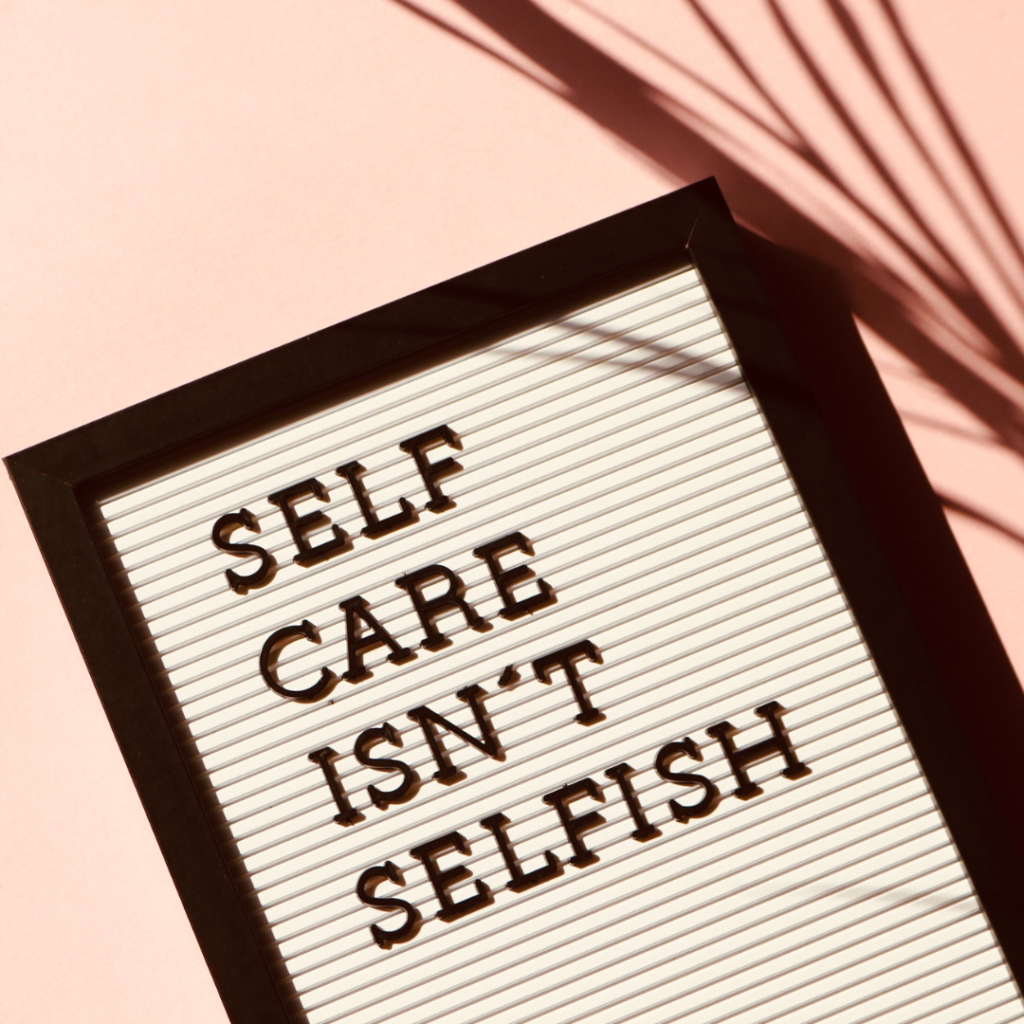
Because I began to understand that taking responsibility for my well-being wasn’t selfish… it was wise.
“You Can’t Pour From an Empty Cup”
We’ve all heard the phrase “You can’t pour from an empty cup” before, but it’s true.
When we are constantly giving without being filled, something begins to break down inside of us. We become irritable, exhausted, and sometimes even resentful.
And that’s not the heart we want to bring into our homes.
Friend, if you feel worn thin right now, can I gently ask you:
What is filling your cup?
Not in a big, unrealistic way—but in the small, quiet moments of your day.
Because self-care doesn’t have to look like a spa day or a weekend away. Most of the time, it doesn’t.
Sometimes it looks like:
- Sitting with your Bible for a few minutes before the house wakes up
- Stepping outside for fresh air
- Taking a short rest instead of pushing through exhaustion
- Saying “no” to something that isn’t yours to carry
These small choices matter more than we think.
A Biblical Perspective: Stewardship, Not Selfishness
One of the biggest misconceptions I had was believing that self-care wasn’t biblical.
But when we step back and look at Scripture, we see we are called to be good stewards of what God has entrusted to us.
And that includes:
- Our bodies
- Our minds
- Our hearts
- Our spirits
Psalm 1 paints a beautiful picture of a tree planted by streams of water—nourished, steady, fruitful.
That kind of life doesn’t happen by accident.
It happens when we are rooted in the right source.
And part of that rooting is learning to receive—not just give.
When Your Worth Feels Tied to What You Do
For a long time, I believed my value came from what I accomplished in a day.
The more I checked off my list, the better I felt about myself.
But that mindset is exhausting, because there is always more to do.
The house will never be completely done.
The to-do list will never be fully finished.
There will always be something else calling for your attention.
And if we’re not careful, we’ll never give ourselves permission to rest.
But God already did.
He created Sabbath—not because He needed rest, but because we do.
There is a deep invitation in that.
An invitation to sit at His feet, like Mary did, and receive before we serve.
“I Don’t Have Time”
When your days are full (and your nights are sometimes even fuller), the idea of self-care can feel unrealistic.
But what if we’ve been defining it the wrong way?
What if self-care isn’t about finding large amounts of time…
but about recognizing small opportunities?
A few quiet minutes.
A real meal.
A short prayer.
A moment to pause instead of rushing.
Sometimes the most spiritual thing you can do is take a nap.
That might not sound profound—but it’s real.
And sometimes, it’s exactly what your body and your spirit need.
Burnout Is Not a Badge of Honor
There was a time when I almost wore my exhaustion with pride.
Look how much I’ve done.
Look how much I’m carrying.
But that kind of striving doesn’t lead to peace.
It leads to burnout.
And that’s not the life God has called us to.
Jesus said that in this world we would have trouble—but He also said He came to give us abundant life.
Not a perfect life.
Not an easy life.
But a life that is rooted in Him… steady, nourished, and full of His presence.
Your Life Is a Gift
If you gave someone a meaningful, thoughtful gift—and they never opened it or used it—how would that feel?
God has given you a life.
Not just responsibilities.
Not just tasks.
A life.
And while it won’t be perfect, it is meant to be lived… and even enjoyed.
As we learn to care for what He has entrusted to us, we begin to experience that life more fully.
A Gentle Invitation
This week, I want to invite you to do something simple:
Ask the Lord,
“How can I take better care of what You’ve given me?”
Not in a way that feels overwhelming—but in small, faithful steps.
And remember… we’re not doing this alone.
We’re learning together.
Closing Prayer
Father,
Thank You for the gift of life—for my body, my mind, my heart, and my spirit.
Teach me how to care for what You have entrusted to me.
Help me to walk in wisdom, not striving.
To rest without guilt.
To receive from You so that I can give from a place of fullness.
Root me in Your truth, Lord, and grow me into a woman who is steady, fruitful, and full of Your peace.
In Jesus’ name,
Amen
If you found this article helpful and you’d like to say thanks, click here to buy Audrey a coffee.